Showing posts with label Passage. Show all posts

Friday, November 18, 2011

Passage to New Zealand

Now that it's over with we can admit it. This is the passage that we were most afraid of. Lots of people sail from Tonga to New Zealand every year and, while they may encounter some unpleasant weather, it usually turns out fine. However there are some notorious exceptions. There was storm off of New Zealand in November of 1998 that hit the people who were making this same passage and it was nasty. Boats sank and people died. In preparation for this trip we read a great book called "Surviving the Storm" about how to read the weather condition and hopefully avoid that sort of thing and how to give yourself the best chance of survival if you do find yourself in really deep sauce. A large portion of the beginning of the book is a detailed description of how that storm developed and what happened aboard the boats that got into trouble. It was quite informative and useful to read but, despite the foreword by the authors that tries to reassure you that this sort of thing is exceedingly rare, it does tend to scare the crap out of you when you're planning to do that same passage yourself during the same month. There, I said it. Aren't all of you friends and family glad I didn't tell you about that before the passage?


So there we were in Tongatapu with Shalimar waiting for a weather window. Shalimar had decided to shell out the money for professional weather routing on this passage so, rather than just pouring over the weather faxes ourselves and hoping we were interpreting them correctly, we just had to wait for Shalimar to get an email from a professional and hope that he was interpreting the data correctly. Okay, actually we looked at the weather faxes and grib files too but it definitely was nice to share Shalimar's weather routing info. Since Shalimar was sailing with a few jury rigged repairs and a broken finger, we were looking for a good weather window rather than just a possible weather window.


We ended up waiting quite a while. November 7th rolled around and by then our standards had slid a little bit. There was a window on offer and we took it. The forecast called for a few days of light wind halfway through and a little more upwind sailing than we wanted but it still looked pretty good. We left on the 7th and started heading SW in winds that were just a little E of S. Those of you that sail will know that going upwind isn't too comfortable. For those of you that don't, I'll tell you. It's not too comfortable. The boat heels way over so that you just about have to walk on the walls when you're below, it seems colder and windier than it really is, the rig is under a lot of stress (which stresses me out as I worry about things breaking), and the boat lurches and jerks as it rams into oncoming waves.


That description of sailing upwind is also a fairly accurate description of the whole 11 day passage except for the 40 or 50 hours we spent motoring because there was either no wind or there was wind blowing directly from where we wanted to go. We also got to experience the joy of only covering about 60 miles over a 24 hour period. All in all it was a mildly annoying and uncomfortable passage but, given the spectrum of things that can happen out there, I will gladly accept it. We made it in a reasonable amount of time, didn't get rained on very much, and nothing broke. I had a bit of a scare when we got to Opua, New Zealand and I found a bunch of oil in the bilge. For a short while I thought we'd blown the main seal on the engine or something but it turned out to be nothing. The engine just doesn't seem to like to run while we're heeled way over. We ended up motoring with the sails up quite a bit to keep our speed up and I guess the crank case breather is low enough that it'll blow oil out when it's leaned way over. So anyway, nothing broke and Architeuthis did good. We got into Opua on the 18th and Shalimar made it in one day later.


We didn't really realize how good we had it until we'd been in Opua for a few days. We saw some old friends in the boat yard here that we hadn't seen since California. They'd also just sailed across be we missed them all the way across because we were on different schedules. Anyway, it turns out they'd made the passage a couple of weeks before us and broke their boom and one of their spreaders and almost lost their mast. They had to turn back to Tonga, tie everything down, buy a ton of diesel cans and motor the whole way to New Zealand. Then some good friends of ours came in about 4 days after us and it turns out they had all sorts of problems you can read about here.


At any rate, we're damned glad to be here and glad that Architeuthis has been such a sturdy (and lucky) little boat.


Monday, August 01, 2011

Leaving Bora Bora

We're going to leave Bora Bora today. We've had some fun here but I don't think it'll go down as our favorite island. It's beautiful but it's a bit overrun with tourists (you know, people like us). To be fair, we haven't fully explored the island. We've been too busy working on stuff to get ready for the slightly longer passages ahead of us. We added some running back stays to stabilize the main mast (probably not necessary but gives us peace of mind), changed the oil and filters, made some improvements to our wind vane set up, and those sorts of things.


Our plan from here to Tonga is as follows: we'll go from Bora Bora to Aitutaki in the Cook Islands, then to Beveridge Reef, then to Nuie, and from Nuie we'll head on to Vava'u in Tonga. Then we'll stay in the various island groups of Tonga until sometime around early November. We were planning to have Rarotonga be our first stop after Bora Bora but it looks like there may be a mild front coming through about the time we plan to get there. The front will bring winds out of the north and from what we've heard, the harbor at Rarotonga (marginal in good conditions) is unsafe with winds from the north. That's why we've changed our plan to Aitutaki. At any rate, the plans are all shown on the map tab. Speaking of maps, I've added a small map on the right side of this page. In theory, that map will display our position reports to the Pacific Seafarer's Net. On multi day passages (like the ones coming up), we'll report our position via ham radio and the operators of the net will update the data set that feeds that little map. It only shows position reports from the last 30 days, so it's not showing anything as of the writing of this post but, if all goes according to plan, it should start to show our position sometime tomorrow.


I'm not sure when we'll have internet access again so we may not be able to update the blog again until Tonga. We may have access sooner but there's no need to worry if you don't see any updates 'til then. We've got to run now. We still need to top off our water tanks, roll up our dinghy, and pay our bill at the Bora Bora yacht club before we can get underway.


Sunday, May 29, 2011

Rough Plans

We may not be able to update again before we head off to the Tuamotus so here's the plan:


We are going to a different bay, just west of here, tomorrow for a big festival they are having to welcome some polynesians arriving on traditional sailing catamarans. After that, we will top off our water and food and head out on Monday or Tuesday. Not sure if we will have internet again before we leave, but our friends on Shalimar have a modem so we can email you from their email if need be to let you know it's time to start checking our position again.

Our rough Tuamotu iterneray is as follows:


4-5 day passage to Makemo atoll

2-4 days in Makemo

1 day passage to Katiu atoll

2? days in Katiu

1 day passage to Tahanea atoll

3-4 days in Tahanea

Overnight passage to Fakarava atoll

5-8 days in Fakarava (internet possible)

Possible stop in Toau, just north of Fakarava time permitting, then on to Tahiti by the end of June, beginning of July. We will be buddy boating with Shalimar. We will only be checking into the Pac Seafarers Net on the passages between here and Makemo and our last atoll (Fakarava or Toau) and Tahiti (the multi-day passages).


Friday, April 29, 2011

Pictures from the passage

It turns out that the internet connection here actually has faster upload speed than download speed. Go figure. Anyway, that means that I managed to get some pictures from the passage up on Picasa. Here's the slide show (which you can click on to take you to a bigger view of the photos):


The Downside of the Passage to the Marquesas

Sheesh. That was tougher than we thought it would be. It was really great in some ways (to me at least - Christine may disagree) but it was certainly arduous. So here are the boring statistics to start with: We left Mexico (Barra de Navidad) at 16:45 UTC (10:45 am local time) on March 26th, 2011 and arrived at Atuona, Hiva Oa in the Marquesas at 01:46 UTC April 25th, 2011 (4:16 pm, April 24th local time). That's a distance of 2,862 nautical miles in 29 days, 9 hours, 1 minute. We motored for 32 hours and ended the trip with about half of our 40 gallon fuel tank and one full 5 gallon jerry can. We started with around 70 gallons of drinking water and another 10 gallons for showering. We ended up with what I would estimate to be about 30 gallons of fresh water and 3 gallons of shower water. Our fastest day covered 148 nm and our slowest was 56 nm. If I haven't messed up any of the calculations, we had an average speed of 4.06 knots. While most of it seemed really slow to us, that's really not too bad for a boat of our size.


Stuff that we didn't like about the passage:


Parts with not enough wind. Obviously, it's no fun to not be making much progress but that's actually the least of your worries when the wind drops. What's really annoying is the rolling around and the flapping of the sails. I don't think it wouldn't be so bad to be becalmed on flat glassy seas but I wouldn't really know because that never happened to us. When we were becalmed, there was always still enough swell and chop to make the boat roll violently. You want to leave you sails up to catch any little breeze but if you leave them up, they flap and jerk all over the place. In addition to being really loud and obnoxious, that's also really hard on the boat's rigging so, if it's calm enough, you have to drop the sails completely. That means you're going nowhere and it lets the boat roll even more because the sails, when they're up, slow the boat's roll. We expected to get becalmed a bit near the equator while transitioning from the NE trade winds above the equator to the SE trades below but thought we'd have fairly steady winds aside from that. It didn't turn out that way at all. We ended up having many calm patches between the coast of Mexico and 120 degrees west. On the other hand, aside from some moderately annoying calm patches around 3 degrees north, the equator region treated us quite well. In fact the equator itself was probably our best sailing of the whole passage. We had 8 - 12 knots of wind on the beam with nice calm seas for around 3 days in a row.


Parts with too much wind. We saw wind over 30 knots a lot more than I thought we would. We don't actually have an anemometer (wind gauge) but we did calibrate our estimates by getting reports from nearby boats but, at any rate, it was windy. The periods of too much wind associated with squalls were not too bad (and we expected some of that on the passage). The squalls would bring high winds that generally only lasted from a few minutes to an hour or so. Being of such short duration, these winds don't raise much in the way of waves so if you pay a little bit of attention and make sure you reef the sails enough before you hit them, they're not a problem. What we didn't like and didn't expect were periods of high wind lasting anywhere from 12 to 72 hours. There was one 36 hour or so period around 9 north, 125.5 west that we really really did not like. I was in the cockpit all night in the rain wearing my foul weather gear. Aside from the frequent lighting up high in the clouds, it was pitch black and the wind was blowing a steady 25 - 30 knots with gusty periods where I'm sure it topped 35. T he seas had been lumpy and confused for at least a couple of days leading up to this and got considerably worse once it really started blowing. We took a number of waves over the stern that filled the cockpit about half full of water during the night and by the morning there were some swells that were at least 15 - 18 feet high. We normally split up the night hours in to separate watches but I didn't bother to wake Christine for two reasons. 1) I didn't think I'd be able to sleep and 2) I didn't want Christine to be out there by herself because it was kind of terrifying.


Barnacles. Apparently, our bottom paint is too old. It's been on the boat for about 2 years so I guess it shouldn't really be a surprise but I thought it would hold out a little better than it did. I did a thorough bottom cleaning a few days before we left Mexico. I expected that we'd grow some barnacles at the waterline and, seeing some there at around 3 degrees north, I got in the water to clean it up and take a look. I had noticed that we were going slower than we should be even while motoring but I was still hoping it was just the waterline. When I got in, I found that it was much worse. The whole bottom was covered with gooseneck barnacles and some other vaguely similar but different kind of barnacle. The prop was completely covered with the hard shelled barnacles we'd been getting in Mexico. I cleaned the prop and as much of the bottom as I could stand to that day. That somewhat improved our speed for motoring through the calm spots but didn't do too much for our speed under sail. Two days later at around 1.5 degrees north, I got in to continue the cleaning. It took a long time and I got stung by jellies and ended up with a bunch of extremely itchy welts that lasted for 4 or 5 days but I got the bottom pretty clean and our progress improved dramatically. I think we picked up at least 1.5 knots with the two cleanings. I suspect that better antifouling paint would have cut at least a day or two off of our passage.


Lumpy confused seas. This was probably the number one misery-maker of our passage and one that we didn't expect. We expected there to be swell - it is the open ocean - but we expected mostly gentle long period swell. Instead we got a whole lot of steep chop and, to make it even worse, steep chop coming from several directions at once. The sails flap and won't stay full, the boat slows down, and worst of all, living conditions deteriorate markedly. Moving around the boat is extremely awkward. It's difficult to sleep even wedged into the sea berth with the lee cloth up. Preparing even simple meals is difficult and, when the stove is involved, dangerous. You can't work on projects, you can't set anything down without it flying across the cabin and, when it's really bad, you can't even read without starting to get motion sick. It might have been a bit better on a bigger heavier boat with a deeper draft but we talked to friends on a 38' Hans Christian and a 46' Island Packet who were generally within about 100 miles of us on the passage and they both complained about the lumpiness of the seas and the rolliness of the boats so I'm more inclined to blame the conditions than to blame Architeuthis.


The Inter-Tropical Convergence Zone (ITCZ). We are not fans of the ITCZ. It's the place near the equator where the northern hemisphere trade winds collide with the southern hemisphere trade winds. This creates a roughly east/west line of clouds, squalls, and thunderstorms is not particularly fun to cross on a sailboat. To make things extra fun, the ITCZ tends to move around all over the place. The first time we crossed it (more on why we crossed it multiple times coming up), we were around 8.5 degrees north and 125 degrees west. According to the surface analysis weather fax (or at least according to my possibly flawed interpretation of it), there was a shear line (a boundary between two air masses) cutting through the ITCZ right there at the same time. Since I'd mostly heard people complain about being becalmed between squalls while crossing the ITCZ, I figured that would be a good thing in that it would give us a bit of extra wind to keep us moving. I wasn't entirely wrong. We got extra wind all right and we did keep moving but it was more than I wanted and we saw way more lightning than I wanted to see. I never saw an actual bolt and there wasn't any thunder so it certainly could have been worse but when you consider how far from land we were (off hand, I'd say the nearest land was at least 1000 miles away) and the fact that wooden masts like ours tend to explode when struck by lightning, you can begin to understand why I left a pucker mark on the cockpit cushion every time the clouds lit up. This was all while Architeuthis was surfing down waves at 7 or 8 knots under only a very reefed headsail under the pitch black of heavy overcast on a moonless night. ...which is a moderately pucker worthy state of affairs in its own right.


I mentioned that the ITCZ moves around a lot, right? It shifts north and south within a range of about 10 degrees of latitude (that's 600 nautical miles) and it shifts fast. I can move 300 miles in a day, no problem, while we never covered more than 150 nautical mile in a day. Our first, and crappiest, encounter with it was at around 8.5 degrees north and that's, from what I understand, about as far north as it gets. So after kicking our collective butt for 30 hours or so, the ITCZ headed south so it could take another swipe at us. I didn't get all the weather faxes every day so I'm not sure how many times we crossed the ITCZ but I'd say it was at least three or four times including the time that it decided to put in a rare appearance all the way down at about 5 degrees south and we managed to catch the edge of it. Some boats got lucky and had a single mild crossing of the ITCZ. We weren't on any of those boats.


Stuff breaking on the boat. While we were out there, I felt like we were having a constant battle with broken stuff. In retrospect and after talking to other people who just made the same passage, I think we actually came through it remarkably well. That being said, here's the list of broken stuff in order of decreasing perceived severity:


  • The fitting for our whisker pole ripped out of the front of our mast. For all you landlubbers, the whisker pole is an aluminum pole that you use to push the headsail out to windward. This allows you to go more directly downwind that is otherwise possible and helps to prevent the sails from flopping around uselessly and jerking on all the rigging when the wind is light and the seas are lumpy. Not only did this mean that we couldn't continue to use what had probably been our most common and comfortable sail configuration (wing on wing - mainsail on one side and genoa on the other), it also ripped some pretty big chunks of wood out of the front of the mast that Christine worked so hard to beautifully refinish last November. We'll be able to repair it in a couple of days when we get to our next anchorage (which is reputedly much less rolly than our current one) but it's still a pisser.


  • Our alternator and regulator. Our regulator is a really low-tech old one and once the engine room gets warm, it will only put a couple of amps into the battery when it should be pumping out at least 15 or 20. I had bought a manually adjustable regulator at a swap meet in Mexico before we left so after an epic struggle to install during a period of lumpy seas with no wind (picture me covered in sweat and cursing loudly while trying to drill holes, run wire, connect stuff, and simultaneously hold onto the boat so I don't get chucked across the cabin), I got the output of the alternator up to an acceptable level and we were off motoring through the calm spot. Then I heard a smoke detector and found the manual regulator too hot to touch and starting to singe the wood that it was mounted on. Fire on your boat in the middle of the ocean is a very scary thing so, after disconnecting it, I paused for a moment to praise Christine for insisting that we get a smoke detector. After that, I employed a trick I found in our sailboat maintenance book by Don Casey and hooked up a light bulb in place of the regulator so now we can charge at a more or less acceptable rate when we run the engine but we have to monitor it carefully to make sure we don't overcharge the batteries. For reasons that are too boring to go into (even for me), I also suspect that things aren't quite right with our alternator so, once we get to Tahiti, I will look into getting a new regulator and a proper 3 stage regulator. None of this is too big a deal because we do almost all of our charging with our solar panels.


  • Our fridge. I guess our fridge didn't really break. It just continued to be an inefficient 30 year old Adler Barbour unit hooked up to a rather poorly insulated icebox. That was okay back home in California where the water is cold and the weather is mild but it's not working out so well down here. When it's running it draws anywhere from 5 to 8 amps depending on its mood and instead of cycling on and off and being off most of the time, it's on about 80% of the time. On the passage, this meant that we had to use the windvane to steer instead of the autopilot because our solar panels couldn't keep up with both. The next bullet point will explain why that was annoying. The proper solution would be to tear apart the galley, improve the insulation, and buy a new fridge unit. There's a chance that could happen after Tahiti (none of the supplies will be available before then) but, more likely, it will wait until NZ and, in the mean time, we'll be buying ice to keep things cool or just doing without cold stuff. We were aware that the fridge was likely to be an issue down here but there just wasn't enough time or money to address it before we left. Oh well, Joshua Slocum didn't need a fridge.


  • 'Jack', the Aries wind vane. Jack found a lot of ways to piss us off on this trip. He broke steering lines and blocks and required endless hours of adjustment and babysitting. I think the bottom line is that servo pendulum wind vanes like the Aries can work with worm gear steering like we have but not as well as you might like. Jack was great when the conditions were just right but quite annoying when the wind was light or the seas were lumpy. 'Otto', our below deck Raymarine autopilot, on the other hand, was great. The only problem was that we didn't have enough electricity to use him all the time. Once we'd run out of perishables (about 2.5 weeks in), we shut off the fridge, folded up the wind vane, and let Otto steer the rest of the way.


  • Lots of other minor things that I can't really think of and aren't that important anyway.


Wow, this has been quite the litany of complaints, eh? For comparison though, consider the problems that other boats had while out on the same passage at pretty much the same time. A Mariner 40 we've made friends with dragged a solar panel in the water (ripping open it's junction box and rendering it useless until they can buy and install a bunch of diodes), ripped a spinnaker to shreds, and had their roller furler fail. A very nice 38' Hans Christian got caught by a squall with too much sail up and got knocked flat enough that their sink drain back flowed and soaked the inside of their boat with salt water. An Island Packet lost its lower shrouds do to a rigger not putting something together right and had to make much of their passage from San Diego to Hiva Oa under jury rig with very much reduced sail. A friend on a custom built ketch got stung by a man-o-war jelly while making some rudder adjustments (that doesn't say anything about the respective merits of anyone's boat but it does make my itchy jelly sting welts look like a walk in the park).


Boats that left significantly before us or significantly after us seem to have had better conditions and to have made faster passages but when compared to the boats that left within a few days as us, we put in a respectable showing. We made it across faster than the Mariner 40 and a very well equipped 46' Island Packet (a different one than the one with the rigging failure). The 38' Hans Christian beat us by a little over a day but considering our size that's still pretty good.


So, in summary, it certainly wasn't a bed of roses but I think we did pretty good. A lot of it kind of sucked at the time but it's a great feeling to be here and to have pulled off the crossing. I'm in no big hurry to make another crossing that long but I'm really glad that we did it. I planned to write another section of this post on things we did like about the crossing (and there were plenty) but that's going to have to wait until another time. I've already spent way too much time sitting here typing this up. There are also a bunch of pictures from the crossing and from Hiva Oa that I want to upload but that may have to wait until a different island with faster internet. In the mean time, here's one small picture from the passage:
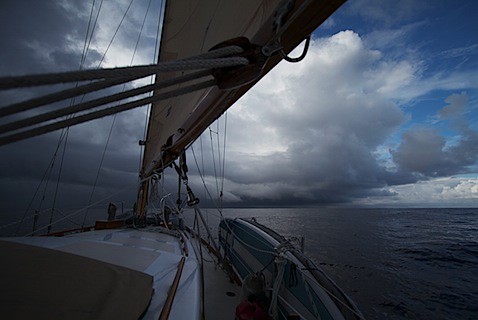


Hey look, it's a squall!


Wednesday, April 27, 2011

Hiva Oa!

We made it! Hiva Oa is beautiful and we're really really happy to be here. I'm borrowing internet account time from a friend while waiting for the account that I tried to set up for myself to actually start working so I've got to be brief right now. I posted the only to blog entries I managed to write while we were on the passage so look back before this one. I'm also going to try to write some more later. I've also got a ton of photos to post but it may be awhile before I can find a good enough connection to do that.


The main conclusion about the passage was that neither of us really enjoyed it as much as we thought we would. The group of boats that left a week or two ahead of us had much better conditions but I guess that's just the luck of the draw. We spent a lot of time with too much or not enough wind and/or really lumpy confused seas that, while not threatening, were uncomfortable and really annoying. We really only had probably about 5 or 6 days worth of the idyllic "trade wind sailing" with consistent 10 - 15 kt wind and smooth seas that we'd read about and were expecting to experience for the majority of the trip. Despite the challenges, Architeuthis handled it pretty well with just a few minor breakages and equipment failures that we'll be able to fix ourselves or work around with no problem. Since arriving, we've spoken to people that came across on much bigger and far more expensive (like on the order of 4 - 8 times) boats that took about the same amount of time (and longer in some cases) and had far more significant problems. We certainly don't want to gloat over other people's problems but we are starting to feel better about our passage.


The anchorage here near the town of Atuona is a little bit on the rolly side and, because it's small and one of only two ports of entry in the Marquesas, is over crowded. Our friend's boat was damaged a few days ago when their neighbor's boat dragged an anchor and bumped them. We've had a couple of close calls with a nearby boat that also dragged so we'd like to get out of here within the next few days. We might have left earlier but we'd like to get some diesel and they ran out a week or two ago and everyone's been waiting on the supply ship that's due in tomorrow. Waiting a bit longer will also give us more of a chance to catch up on posting to the blog and emailing people. It looks like internet access may be a bit more spotty than I'd hoped. In the Marquesas, it may only be available on Hiva Oa and Nuku Hiva and since we plan to visit at least two of the other islands we may be out of touch for a while.


Anyway, that's all for now. Hopefully there will be more soon.


Friday, April 22, 2011

Lethargy at Sea

You know that previous post about the first day out on the passage? Well, I started that post on the first or second day of the trip but didn't finish it until about two weeks later and this, the next post, I just now started and we're probably less than 24 hours from the end of the passage to the Marquesas. This was not the plan. The plan was to write a post every couple of days so that, when we arrived at an internet connection, I could post an exhaustive account of the passage. Other facets of the plan included things like learning french and reading a bunch of scientific journal papers and other productive uses of all the spare time we'd have. Well, very little of that productive stuff happened, least of all the blog post preparation.


What happened? Well, I can't really claim that there was a lack of free time. There were sporadic gobs of free time but most of it was a weird sort of low quality free time that I hadn't expected. When the winds were light, we were busy constantly messing with the sails try and keep the boat moving and prevent the sails from flapping around uselessly and jerking the rigging around. When it was blowing really hard, we were busy worrying, adjusting stuff, and generally just being scared. On the many occasions when things were broken, we were busy fixing them and cursing loudly. On the fairly rare occasions when the seas were calm and the wind was just right, we wanted to relax and enjoy the moment rather than type on the computer. Ruling out these circumstances, there was still a pretty significant amount of time to waste but it turns out that most of this remaining free time was crappy low-quality free time. We spent a pretty large percentage of our passage in really lumpy confused seas while trying to sail nearly dead downwind. This creates a pretty unpleasant and unpredictable motion on the boat. Sitting in one place isn't too bad but the normal daily tasks you don't usually even think about become quite a chore. Doing dishes, getting dressed, taking a leak, eating... all those things become such a nuisance as the boat does it's best to bounce you off the walls and ceiling that you use up all your energy just existing. Combine this with the mild sleep deprivation inherent in having a two person crew and you end up in a sort of sea torpor.


Once one enters this state and becomes a sea-sloth, the list of acceptable pastimes shortens significantly and the thought of doing anything productive becomes anathema. Acceptable sea-sloth pastimes include staring at the walls, thinking about productive things that you should be doing, wondering what important piece of equipment is going to break next, and making half-hearted threats and obscene gestures at dolphins and sea-birds. "You keep ridin' my bow wave Flipper and you're liable to end up with a boat hook in your blow hole." "I didn't epoxy and paint those spreaders so that some stupid booby could stand on 'em and crap all over my deck. You and your blue feet can get the !#@& out of here." Sure that was kind of fun for a while but the number one pastime of the sea-sloth ended up being reading. You could wedge yourself into a corner with a book or, more often, a Kindle and give your brain a rest from the current circumstances. I've read at least 13 books on the Kindle since we left Mexico but I've kind of lost track at this point. So, yeah, instead of writing blog entries I've been reading novels.


It doesn't seem like typing up a blog entry should be such a chore but there's something about typing and staring at a computer screen while rolling around in a boat that is particularly unpleasant. As much as I'm sure I'll someday regret not having written more, I don't foresee any major improvements in my blogger work ethic on the horizon. I think that part of what happens is that I get behind a few days and end up feeling like I have to write about everything that's happened since my last post. I get overwhelmed by the thought of all that writing and just give up altogether on the idea of comprehensive blow-by-blow coverage (If you've been reading this blog since we left California, you probably had no idea that kind of coverage was even a goal). I was thinking of making another post right after this one but I think I'm going to go read more of the Elmore Leonard novel I started yesterday.


Sunday, March 27, 2011

First Day of the Passage from Mexico to the Marquesas

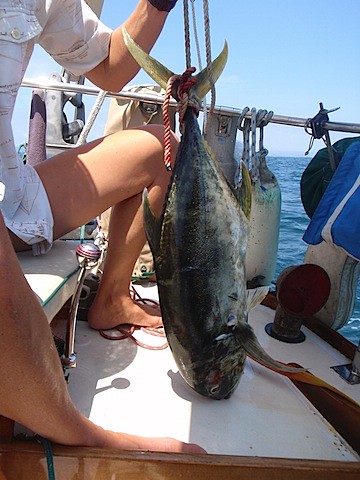
We left Barra de Navidad yesterday (March 26th, 2011) at around 11am. The winds were pretty light and directly out of the west (the direction we wanted to go) for the first few hours. There were sea birds diving all around us and we could see the water roiling with bait fish and their predators so we decided to put a line in the water and see what happened. Given our dismal record as fishermen (fisherpeople?), we weren't really expecting to catch anything. I had put the rod in its holder on the rail and started to work on the daily lubrication of the windvane steering system (see previous entry on the subject) when the line started paying out of the reel. My first reaction was to accuse Christine, who was sitting near the rod, of bumping it and letting line out. Thankfully, she pointed out the obvious for me; there was actually a fish on the line.


This was my first time with a fish over the size of about ten inches on a line and I wasn't entirely sure what I was supposed to do so, like any good American, I just did what I'd seen people do on TV. I took the rod out of the holder, braced in on my waist, let the fish run a bit of line out, increased the line tension, yanked the rod up in the air when I felt a little slack, and cranked the reel as I brought the pole back down. Apparently, this was the correct thing to do because I soon had some sort of tuna flopping around on the deck. It actually was pretty damn fun to reel the critter in, see what it was, and hoist it on deck. I can understand a bit of why people get so into sport fishing but there was one problem. Once we had it on deck, we quickly realized that while we knew the general principles of what comes next, we were really fuzzy on the details.


Christine gaffed our catch on to the deck where it promptly started to bleed all over the place. I knew that some violent clubbing of the fish's head was called for so I looked around from something club like. The only thing at hand was a long metal handle for our windless so I used that to whacked the crap out of fishy friend. More blood followed and this was where our grasp of fishing procedures ended and Christine had to consult a fishing handbook that we had on board. Turns out there's a lot to the process of killing one of these things correctly. Who knew? We followed the instructions as best we could and got some big fillets out of it but the meat was very dark. We ate as much of it as we could but it didn't taste great. I think we blew it on the processing and we felt pretty bad about killing a decent sized fish that high up in the food chain - not to mention the mess we made on deck - so we made a new rule. We will do no more fishing until two conditions are satisfied: 1) Our supply of fresh meat is exhausted. 2) We read up on how to properly kill these things for maximum tastiness.


P3261323


Just to make matters more entertaining, we were under sail the whole time this was going on and with all the fish handling, boat handling took a back seat so we were steering a somewhat erratic course. It just so happened that the Mexican navy was within sight and decided to motor over on their big scary looking steel boat to have a look at us. We smiled and waved as they came around behind us and photographed the back of our boat, presumably to read our name and hailing port off the transom. Just as they passed behind us, I managed to lose hold of the bucket I was using to pull up salt water to rinse the deck with and it went overboard. So, within plain view of the navy, we tacked around awkwardly while still managing fishing gear and made a failed attempt to retrieve our bucket. Oh well, we have lots of buckets.